Company ' S Strategy
 At all stages of economic development and production management, there was a need to motivate workers to achieve the desired results. Various types of work were developed theory of motivationon the basis of which the motivational process was organized. Individuals have different needs, have different goals to meet them and take different actions to achieve their objectives. These circumstances should be taken into account in the development of the motivation process. According to the original definition of F. Herzberg, there are two types of motivation [1]:
(1) Internal motivation - self-propelled factors that influence people by making them act in a certain way or move in a certain direction. These factors include: accountability (the perception that work is important, control of its own resources), independence (freedom of action), the ability to use and develop skills and capabilities, interesting and challenging work, enabling opportunities for promotion;
(2) Foreign motivation is what people do to motivate them. The Panel includes remuneration (inflated pay, praise, promotion) and penalties (disciplinary measures, pay retention and criticism).
The basic requirements for job satisfaction are comparatively high and fair wages, career opportunities, tactical and collegial leadership, sound social interaction at work, interesting and diverse tasks, and the cumbersome independence of the regulation of the pace and methods of work.
The satisfaction of the individual depends both on its own needs and expectations and on the working environment.
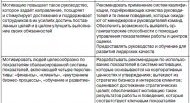
Studies have found no sustainable link between job satisfaction and labour indicators. Satisfactory worker does not always yield good results in work, and those who regularly show high productivity results are not always satisfied with work. The assertion that high performance results in satisfactory performance was also not proved. Financial incentives, in particular money, can provide positive motivation not only because people and people want to have them, but also because they are a very tangible means of recognition. However, poorly planned and poorly managed pay systems can reduce motivation. In the pill. 1 Synthesis of factors that influence motivation strategies and contribute to the ability of staff management specialists to increase motivation.


Related posts:
 The staff motivation system in the enterprise. The motivation of staff is traditionally understood as the award of staff for the performance and over-completion…
 New articles to what do dances and arts teach? I was once convinced that arts and dances taught to hit a face with unconscious citizens and then dance like Indian…
 In addition, there is a need for some time to adapt to work after a long absence of a staff member. The most frequent period is a few days. At the time of each of…
 The Office of Staff Social Development aims to improve the microclimate in the collective and to significantly improve the performance of each individual. Let us…
 The deterioration of the countrys economic situation is not only dangerous to the probability of material problems and to the loss of its place in the bottom of…
 Different staff motivation systems are increasingly important in modern management theory and practice. The effective use of the enterprises labour resources is…
 Continuing a series of articles on motivational programmes for sellers not their direct employers - retail networks, namely brands, which sellers themselves offer…
 Each innovation affects the internal environment of the organization and requires adaptation to the changes of the organization itself and its staff. Employees see…
 J. P., Chief Economist of the Kemerobir OAO Alpha Bunk Operations Office The motivation of the staff of service providers is being considered, in this case, in the…
 It is likely that there will be little doubt that the main purpose of any commercial organization is to obtain the greatest possible profit. This is the responsibility…