Oil Theory
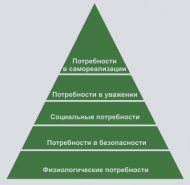 The question of motivation may be the most important in all personology. Maslow believed that people were motivated to seek personal goals, and that made their lives significant and meaningful. Indeed, motivational processes are the heart of the humanistic theory of the individual. Maslow described a man as an " desirable creature " , who rarely achieved a state of complete, completed satisfaction. Full absence of desires and needs when (and if) it exists, at best, not for long periods. If one need is satisfied, another falls into the surface and directs the attention and efforts of the individual. When a person satisfies her, another noise demands satisfaction. Human life is characterized by people almost always wanting something.
Maslow assumed that all human needs were congenital or instinctive and that they were organized in a hierarchical system of priority or domination.
- Physical needs are necessary for survival. They include food, water, shelter, recreation and sexual needs.
- Safety and security needs in the future include environmental protection needs against physical and moral hazards and confidence that physiological needs will be met in the future.
- Social needs, sometimes called a need for complicity, including a sense of belonging to someone or something, a sense of social interaction, attachment and support.
- The need for respect includes self-respect, personal achievements, competence, respect by others, recognition.
- Self-expression needs - the need to realize their potential and growth as individuals
The Maslow has formulated three fundamental assumptions about human nature, which form the basis of its theory:
- People are the essence of needy creatures whose needs can never be met;
- The condition of partial or total dissatisfaction leads a person to act (according to Maslow, “the best way to encourage someone to seek love is to deny it”);
- There's a hierarchy of needs... ♪
Related posts:
 The staff motivation system in the enterprise. The motivation of staff is traditionally understood as the award of staff for the performance and over-completion…
 New articles to what do dances and arts teach? I was once convinced that arts and dances taught to hit a face with unconscious citizens and then dance like Indian…
 In addition, there is a need for some time to adapt to work after a long absence of a staff member. The most frequent period is a few days. At the time of each of…
 All human activities are driven by real needs. The workers own work, depending on the internal motivations and conditions of the external environment, determines…
 MainEntrepreneurIntangible motivation of staff to return to the Personnel Modification Attention! If this material is useful to you, you can add it to your browser…
 Continuing a series of articles on motivational programmes for sellers not their direct employers - retail networks, namely brands, which sellers themselves offer…
 Each innovation affects the internal environment of the organization and requires adaptation to the changes of the organization itself and its staff. Employees see…
 J. P., Chief Economist of the Kemerobir OAO Alpha Bunk Operations Office The motivation of the staff of service providers is being considered, in this case, in the…
 It is likely that there will be little doubt that the main purpose of any commercial organization is to obtain the greatest possible profit. This is the responsibility…
 The growing demand for enterprise business process systematization is primarily due to the main objective of building business processes, the desire to improve business…